Suggested control antibody for E4NG (#10170)
| ||
| 100 µg / 0.1 mL |
For bulk orders, please contact info@vacara.se to request a quote.
Price is excluding shipping cost. The shipping cost will be added on.
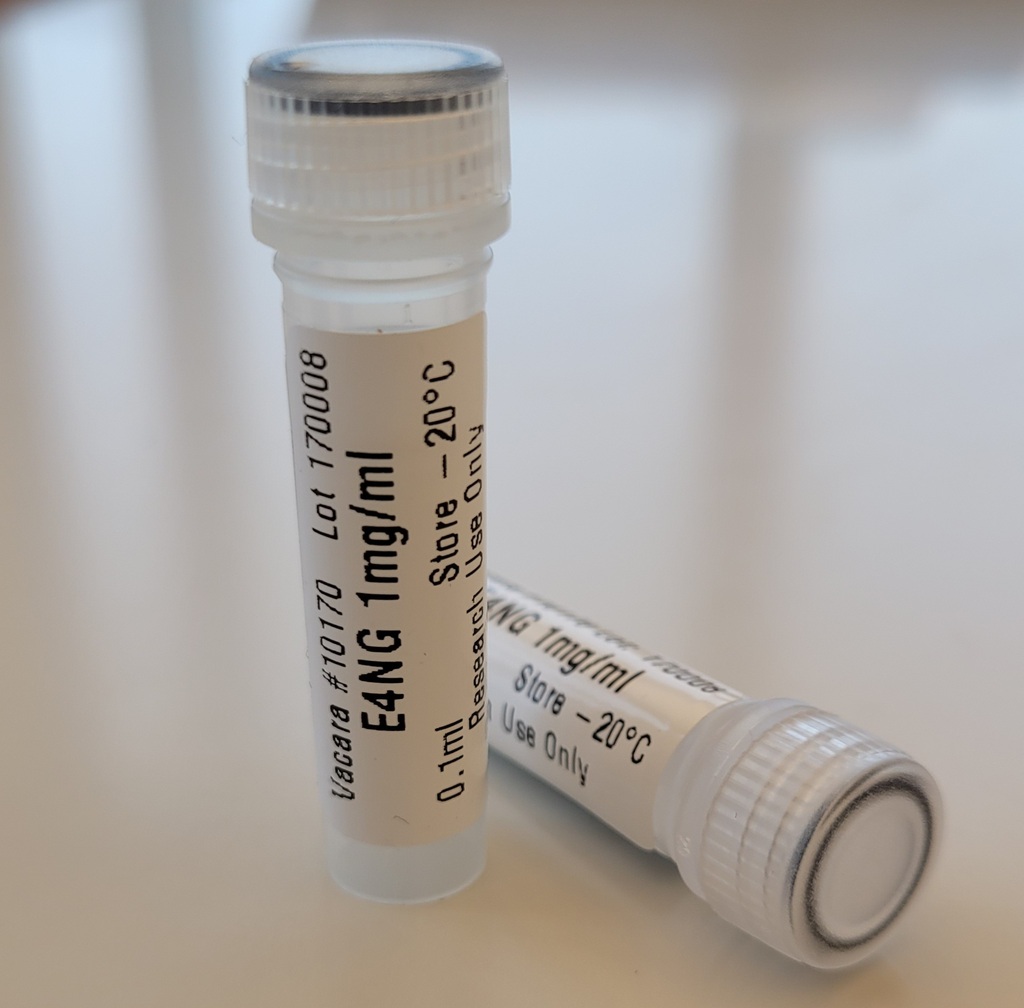
Description
This antibody is the mutated version of the E4NG antibody, with identical sequence, methods of production/purification and format to E4NG except two mutations in the paratope (W48M & S51A)1. This antibody has neglectable or no affinity to citrulline and does not have known cross-reactivity to other antigens1.
The E4NG-mutant antibody is recommended to be used as a control for E4NG antibody (#10170) in assays detecting citrulline-specificity of anti-citrullinated protein antibodies (ACPA) and is packed with product #10170 only and not sold separately.
Isotype
Mouse IgG2b, κ
May have minimal non-specific binding to CCP2, the cyclic citrullinated peptide(s) of the second generation of the anti-CCP test. The antibody does not react with known citrullinated proteins or peptides. Suitable to be paired with E4NG antibody (#10170) as a negative control for detecting citrullinated antigens.
Concentration
100 µg/ml
Size
50 µg/ 0.5 ml
100 µg/ 1.0 ml
Supplied in
PBS
Storage
Centrifuge briefly prior to opening vial. Store at +4°C short term (1-2 weeks). Aliquot and store at ‑20°C long term. Avoid repeated freeze/thaw cycles.
It is recommended the user determines the optimal dilution with E4NG for their application.
For Research Use Only. Not for use in diagnostic procedures.
Not for resale without express authorization.
References
He, Y., Ge, C., Moreno-Giró, À. et al. A subset of antibodies targeting citrullinated proteins confers protection from rheumatoid arthritis. Nat Commun 14, 691 (2023). https://doi.org/10.1038/s41467-023-36257-x
https://www.nature.com/articles/s41584-019-0244-4
https://www.nature.com/articles/s41467-023-36257-x
https://www.sciencedirect.com/science/article/pii/S0003496725009021
Taking the advantage of the well characterized epitope specificity and function, the antibody is highly flexible for adaptation in different purposes. The most common assay is ELISA, where the antibody could be used for capturing certain citrullinated or native COL2 epitopes. In immunofluorescence analysis, E4 binds strongly arthritic mouse joint cartilage. It also binds to naive or arthritic skin and esophagus tissue, ressembling the nature of typical ACPA.