Patent protected (US11866512B2)
Derived from patients with rheumatoid arthritis Suggested control antibody: E4NG-mutant (#10180)
| 100 µg / 0.1 mL | 500€ |
For bulk orders, please contact info@vacara.se to request a quote.
Price is excluding shipping cost. The shipping cost will be added on.
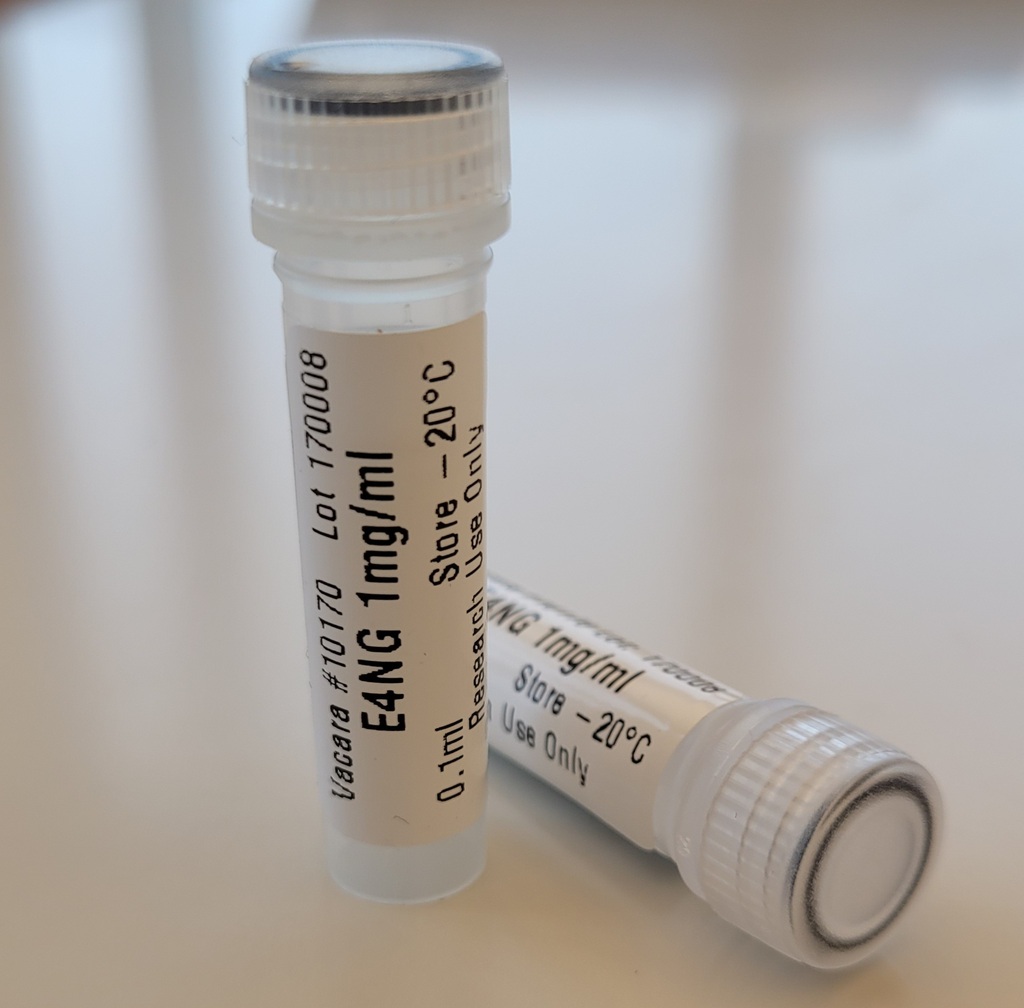
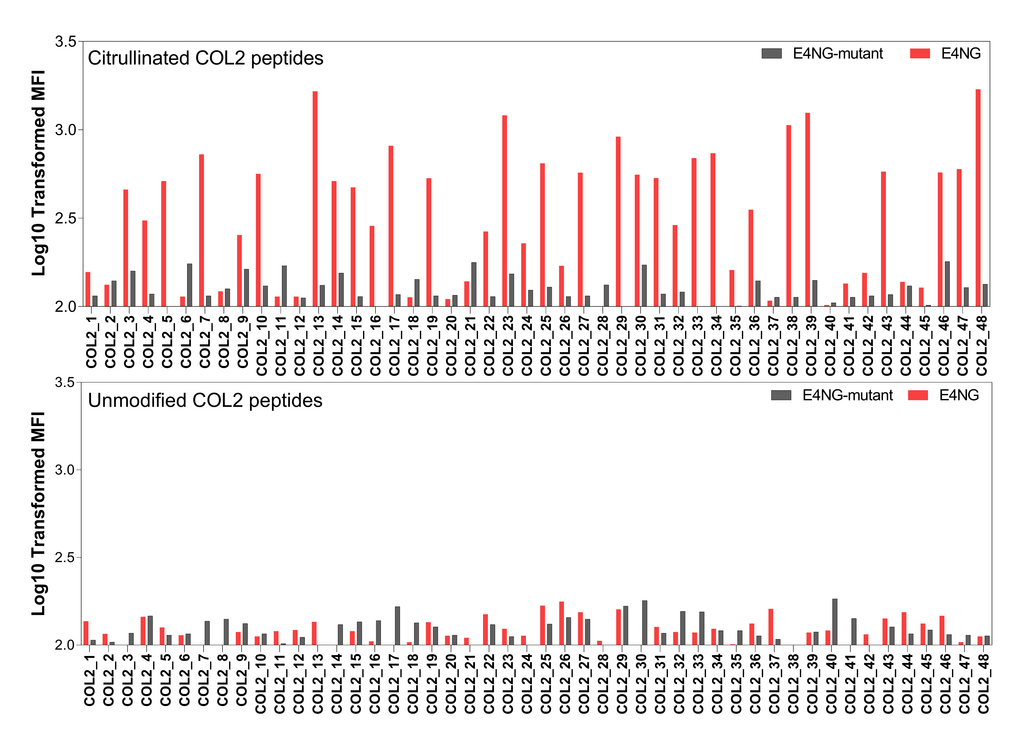
E4NG binds to citrullinated collagen type II (COL2) epitopes. E4NG-mutant is the control antibody that does not bind to citrulline. Binding to unmodified COL2 peptides is low by both E4NG and E4NG-mutant antibodies. Binding was determined by a multiplex flow immunoassay. (Results published in He et al Nat Comm 2023)
Description
Affinity purified mouse monoclonal anti-citrullinated protein antibody (ACPA) clone E4NG in PBS, sterile filtered (0.2 µm). The antibody was originally derived from rheumatoid arthritis (RA) patient, selected by single B cell isolated from RA patient with high reactivity to cyclic citrullinated peptide 2 (CCP2). The chimeric antibody is recombinantly expressed in HEK cells as chimeric antibody (human variable domain + mouse constant domain). The antibody recognizes multiple citrullinated proteins/peptides including CCP2, citrullinated collagen type 2 (COL2) peptides, citrullinated human/mouse alpha-enolase (citENO1) etc1., and potentially other citrullinated proteins/peptides typically manifested in RA, as a citrulline-specific antibody. E4NG has mutation on glycosylation sites in the variable domain, prohibiting expression of the Fab-glycan (no N-glycosylation on variable domain). E4NG has been used in applications including ELISA, multiplex immunoassay, immunohistochemistry and immunoprecipitation etc., and is therefore an ideal antibody for detecting citrullinated antigens. Additionally, in vivo and in vitro functional analysis also demonstrated that E4NG ACPA could protect against collagen antibody induced arthritis (CAIA) in mice.
Targets with alternative names
Citrullinated epitopes of COL2, Collagen alpha-1(II) chain, COL2A1, type II collagen, CII1; UniProt: P28481, P02458.
Citrullinated epitopes of ENO1, MPB11; UniProt: P06733.
Species reactivity
Mouse, human
Mouse IgG2b, λ
The antibody widely recognizes citrullinated epitopes of different proteins, tested with CCP, citrullinated COL2 peptides and citrullinated ENO1, but likely with more untested citrullinated antigens.
Concentration
1 mg/ml
Supplied in
PBS
Storage
Centrifuge briefly prior to opening vial. Store at +4°C short term (1-2 weeks). Aliquot and store at ‑20°C long term. Avoid repeated freeze/thaw cycles.
It is recommended the user determines the optimal dilution for their application. The typical starting working dilutions: ELISA 1:500-1:1000, IHC 1:100-1:500.
For Research Use Only. Not for use in diagnostic procedures.
Not for resale without express authorization.
References
https://www.nature.com/articles/s41584-019-0244-4
https://www.nature.com/articles/s41467-023-36257-x
https://www.sciencedirect.com/science/article/pii/S0003496725009021
Taking the advantage of the well characterized epitope specificity and function, the antibody is highly flexible for adaptation in different purposes. The most common assay is ELISA, where the antibody could be used for capturing certain citrullinated or native COL2 epitopes. In immunofluorescence analysis, E4 binds strongly arthritic mouse joint cartilage. It also binds to naive or arthritic skin and esophagus tissue, ressembling the nature of typical ACPA.