
Products

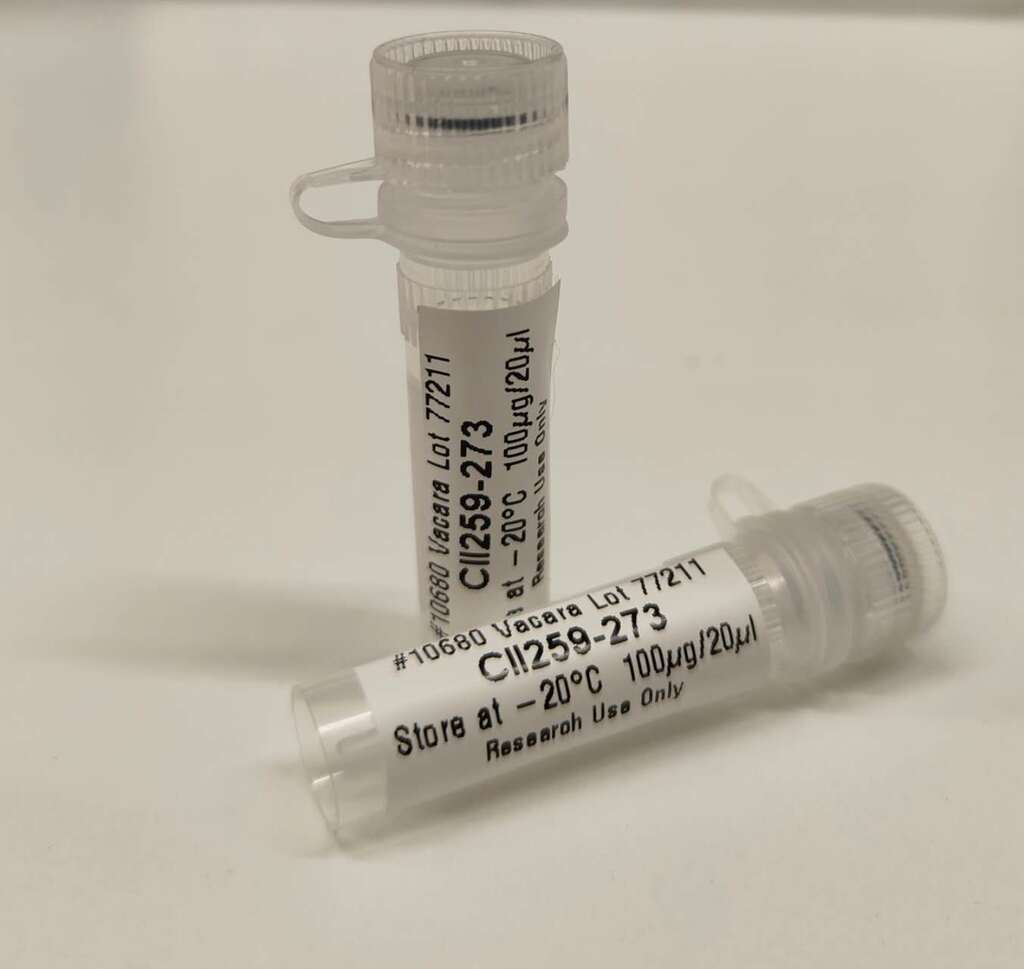
CII peptide (CII259-273)

CII peptide (CII259-273)

Product number #10680 


A Peptide for studies on T-Cell Responses Associated with Autoimmune Arthritis


Size

10 µg
22.9 €
100 µg
128  €


For bulk orders, please contact info@vacara.se to request a quote.

Price is excluding shipping cost. The shipping cost will be added on.
Product details

Description

The CII peptide (CII259-273) contains the 259 to 273 sequence of rat CII. It is the non-galactosylated peptide that is ideal to serve as the control peptide for the Galactosylated CII peptide (CII259-273-GalHyl264; product numbers #10510 and #10550).

The Galactosylated CII peptide (CII259-273-GalHyl264; #10510 and #10550) is the dominant T-cell epitope in collagen induced arthritis (CIA) in mice1. The Galactosylated CII peptide (CII259-273-GalHyl264) activates autoimmune T-cells when presented by the MHC II Aq protein2. The CII peptide (#10680) may be used as a control peptide for the in vitro stimulus by the Galactosylated CII peptide (CII259-273-GalHyl264) in antigen-specific T-cell recall assays for quantitation of T cell activity 1,2,3,4,5 as determined by the selected readout by ELISA, ELISpot, flow cytometry or RNAseq, e.g.


Sequence

H2N-Gly-Ile-Ala-Gly-Phe-Lys-Gly-Glu-Gln-Gly-Pro-Lys-Gly-Glu-Thr-COOH


Peptide backbone sequence origin

Collagen alpha-1(II) chain, COL2A1, type II collagen, CII; UniProt: P05539.


Size

100 µg / 20µl; (available also as 10µg)


Supplied in

0.1M acetic acid


Molecular weight

1475.62 g/mol


Storage

It is recommended to store the peptide in aliquots at -20°C, or preferably at -80°C, unless stability data would suggest otherwise. If the peptide is stored less than 48 hours before use, the peptide may be stored at 5°C (or room temperature). Avoid repeated thawing and freezing procedures.


Recommended dilution

It is recommended that the user determines the optimal dilution for their application. For in vitro T cell stimulation, a concentration of 10 μg/ml5 and a concentration of 20 µg/ml for IL-17 ELISpot assays4 has been used.


For Research Use Only. Not for use in diagnostic procedures.
Not for resale without express authorization.

References

  1. Michaëlsson E, Andersson M, Engström A, Holmdahl R. Identification of an immunodominant type-II collagen peptide recognized by T cells in H-2q mice: self tolerance at the level of determinant selection. Eur J Immunol. 1992 Jul;22(7):1819-25. PMID: 1378019
  2. Andersson IE, Andersson CD, Batsalova T, Dzhambazov B, Holmdahl R, Kihlberg J, Linusson A. Design of glycopeptides used to investigate class II MHC binding and T-cell responses associated with autoimmune arthritis. PLoS One. 2011 Mar 15;6(3):e17881.  PMID: 21423632.
  3. Lindgren C, Andersson IE, Berg L, Dobritzsch D, Ge C, Haag S, Uciechowska U, Holmdahl R, Kihlberg J, Linusson A. Hydroxyethylene isosteres introduced in type II collagen fragments substantially alter the structure and dynamics of class II MHC A(q)/glycopeptide complexes. Org Biomol Chem. 2015 Jun 14;13(22):6203-16.. PMID: 25960177.
  4. Klocke K, Sakaguchi S, Holmdahl R, Wing K. Induction of autoimmune disease by deletion of CTLA-4 in mice in adulthood. Proc Natl Acad Sci U S A. 2016 Apr 26;113(17):E2383-92. PMID: 27071130.
  5. Merky P, Batsalova T, Bockermann R, Dzhambazov B, Sehnert B, Burkhardt H, Bäcklund J. Visualization and phenotyping of proinflammatory antigen-specific T cells during collagen-induced arthritis in a mouse with a fixed collagen type II-specific transgenic T-cell receptor β-chain. Arthritis Res Ther. 2010;12(4):R155. PMID: 20682070

FAQs

Q1: What is Galactosylated CII peptide (CII259-273-GalHyl264)

  • Galactosylated CII peptide (CII259-273-GalHyl264) is a synthetic glycopeptide containing amino acids 259–273 of rat type II collagen (CII), with a β-D-galactopyranosyl modification on L-hydroxylysine at position 264 (GalHyl264). It is the dominant T-cell epitope in collagen-induced arthritis (CIA) models in mice, recognized by MHC II Aq-restricted T-cells.

Q2: What are the research applications of CII259-273-GalHyl264 and CII259-273

  • The peptide is used in autoimmune arthritis research and related T-cell studies:

    Antigen-specific T-cell recall assays to measure autoimmune T-cell activation.

    In vitro stimulation via ELISA, ELISpot, flow cytometry, or RNAseq.

    Collagen-induced arthritis (CIA) models in mice.

    Peptide-based tolerizing vaccine development against autoimmune arthritis.

    Mechanistic studies of MHC II Aq peptide presentation and autoimmune T-cell activation.

Q3: What assays are compatible with CII and Galactosylated CII peptides?

  • The peptides are validated for:

    ELISA (cytokine profiling)

    ELISpot (IFN-γ and IL-17 responses)

    Flow cytometry (activation markers)

    RNAseq (transcriptional profiling of CII-reactive T-cells)

These methods quantify antigen-specific T-cell activation.

Q4: Why use the non-galactosylated CII peptide as a control?

  • The non-galactosylated CII259–273 peptide is essential as a negative control because the Galactosylation at Hyl-K264 is the critical structural feature that determines its recognition by autoreactive T-cells presented by the MHCII Aq molecule. Using the control ensures that the observed T-cell activity is specifically due to the glycosylated epitope, not just the peptide backbone.

Q5: What concentrations of peptides are recommended for in vitro T-cell stimulation?

  • Based on published CIA studies:

    10 μg/ml for general T-cell activation

    20 μg/ml for IL-17 ELISpot

Optimal concentrations may vary between assays.

Q6: What are the best long-term storage conditions for the CII peptides?

  • It is strongly recommended to store the peptides in aliquots at −20°C or −80°C to maintain long-term stability. For short-term storage under 48 hours, peptides may be kept at 5°C or room temperature. Repeated freeze–thaw cycles should be avoided.

Q7: Are these peptides suitable for inducing arthritis in vivo?

  • The Galactosylated CII peptide is the dominant T-cell epitope in CIA and plays a key role in immune activation, but CIA induction requires full type II collagen, not isolated peptides. The peptides are primarily used in vitro, not for induction of arthritis in vivo.

Q8: Can these peptides be used in tolerizing vaccine research?

  • Yes. The Galactosylated CII peptide has been used in peptide-based tolerizing vaccine studies targeting antigen-specific autoimmune T-cells, as shown in Urbonaviciute et al., PNAS 2023.