Products

Mouse Anti- Cartilage Oligomeric Matrix Protein Antibody (16B5)

Mouse Anti- Cartilage Oligomeric Matrix Protein Antibody (16B5)

Product number #10150 


Affinity purified mouse monoclonal Anti-Cartilage Oligomeric Matrix Protein (COMP) antibody clone 16B5 in PBS, sterile filtered (0.2 µm)


Size and Prices

100 µg / 0.1 mL249 €
1 mg / 1 mL1,200 €


For bulk orders, please contact info@vacara.se to request a quote.

Price is excluding shipping cost. The shipping cost will be added on.
Product details

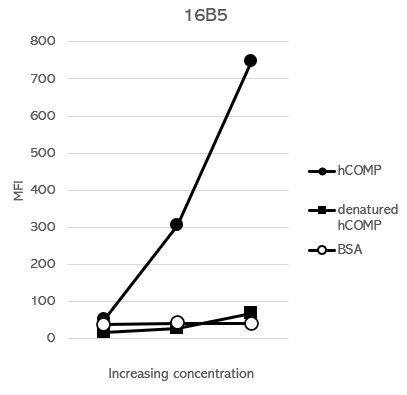
16B5 binds to COMP (hCOMP, recombinant human COMP) but not to denatured COMP. Binding was determined in bead-based flow immunoassay as median fluorescence intensity (MFI). Bovine serum albumin (BSA) was used as the negative control.


Description

Affinity purified mouse monoclonal Anti- Cartilage Oligomeric Matrix Protein (COMP) antibody clone 16B5 in PBS, sterile filtered (0.2 µm). The 16B5 antibody binds to the coiled-coil domain or pentamer COMP1. This antibody has been used in applications including immunohistochemistry (IHC)1 and ELISA1,2.

Target with alternative names

Cartilage Oligomeric Matrix Protein; COMP; 
UniProt Q9R0G6

Immunogen

Rat Cartilage Oligomeric Matrix Protein1

Species reactivity

Rat, mouse, human1

Isotype

Mouse IgG1, κ

Concentration

1mg/ml

Sizes available

100µg and 1mg

Supplied in

PBS

Storage

Centrifuge briefly prior to opening the vial. Store at +4°C short term (1-2 weeks). Aliquot and store at ‑20°C long term. Avoid repeated freeze/thaw cycles.

Recommended dilution

It is recommended the user determines the optimal dilution for their application. The typical starting working dilutions are: IHC 1:100, ELISA 1:200-1:500.


For Research Use Only. Not for use in diagnostic procedures.
Not for resale without express authorization.


References

  1. Geng H, Nandakumar KS, Pramhed A, Aspberg A, Mattsson R, Holmdahl R. Cartilage oligomeric matrix protein specific antibodies are pathogenic. Arthritis Res Ther. 2012 Aug 20;14(4):R191. PMID: 22906101.
  2. Geng H, Nandakumar KS, Xiong L, Jie R, Dong J, Holmdahl R. Incomplete B cell tolerance to cartilage oligomeric matrix protein in mice. Arthritis Rheum. 2013 Sep;65(9):2301-9. PMID: 23754310.

FAQs

Q1: What epitopes does ACC1 bind?

Q2: Can ACC1 induce experimental arthritis?

    ACC1 has been extensively characterized in animal models, one typical utilization is for collagen antibody induced arthritis (CAIA). However, ACC1 alone cannot induce CAIA, it is usually combined with other monoclonal antibodies (e.g. M2139) as a cocktail to enhance the arthritogenic potency. 

    https://www.nature.com/articles/s41467-023-36257-x

Q3: Which assays can ACC1 be used for?

    Taking the advantage of the well characterized epitope specificity, the antibody is highly flexible for adaptation in different purposes. The most common assay is ELISA, where the antibody could be used for capturing certain citrullinated or native COL2 epitopes. In immunohistochemistry (IHC) analysis, ACC1 binds strongly to naive or arthritic mouse joint cartilage. It also binds to psoriatic skin and esophagus tissue, ressembling the nature of typical ACPA.

    https://link.springer.com/article/10.1186/s13075-022-02945-0

Q4: Which secondary antibody should I choose for ACC1?

  • The isotype of ACC1 is mouse IgG2a (please contact us for other isotypes). We have tested the antibody in multiple assays and can confirm that conventional anti-mouse IgG products are ideal as a secondary antibody. Optionally, anti-mouse kappa secondary antibody also performs similarly well.

Q5: Do you provide labeled/tagged version of this antibody?

  • We have biotinylated version for most of our monoclonal antibodies, please contact us for details.