Products

Mouse Anti- Cartilage Oligomeric Matrix Protein Antibody (15A11)

Mouse Anti- Cartilage Oligomeric Matrix Protein Antibody (15A11)

Product number #10140 


Affinity purified mouse monoclonal Anti-Cartilage Oligomeric Matrix Protein (COMP) antibody clone 15A11 in PBS, sterile filtered (0.2 µm)


Size and Prices

100 µg / 0.1 mL249 €
1 mg / 1 mL1,200 €


For bulk orders, please contact info@vacara.se to request a quote.

Price is excluding shipping cost. The shipping cost will be added on.
Product details

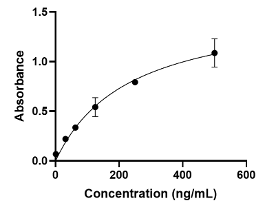
The mouse monoclonal anti- Cartilage Oligomeric Matrix Protein (COMP) antibody clone 15A11 binds to the fourth EGF (epithelial growth factor) -like domain of murine COMP, comprising residues 232–252, called the P6 epitope. Binding to recombinant human COMP (Product number #10020) was determined in enzyme linked immunosorbent assay (ELISA) as absorbance at 405nm.


Description

Affinity purified mouse monoclonal anti- Cartilage Oligomeric Matrix Protein (COMP) antibody clone 15A11 in PBS, sterile filtered (0,2 µm). The 15A11 antibody binds to the fourth EGF (epithelial growth factor) ‑like domain of murine COMP, comprising residues 232–252, called the P6 epitope1. This antibody has been used in applications including immunohistochemistry (IHC)1, and in vivo functional assays2.


Target 

Cartilage Oligomeric Matrix Protein; COMP; 
UniProt: Q9R0G6

Immunogen

Rat Cartilage Oligomeric Matrix Protein1

Species reactivity 

Rat, mouse, human1

Isotype 

Mouse IgG1, κ

Concentration

1 mg/ml

Sizes available

100 µg / 0.1mL

1 mg / 1mL

Supplied in

PBS

Storage

Centrifuge briefly prior to opening vial. Store at +4 °C short term (1-2 weeks). Aliquot and store at ‑20 °C long term. Avoid repeated freeze/thaw cycles.

Recommended dilution

It is recommended the user determines the optimal dilution for their application. The typical starting working dilution for IHC is 1:100.

For Research Use Only. Not for use in diagnostic procedures.
Not for resale without express authorization.

References

  1. Geng H, Nandakumar KS, Pramhed A, Aspberg A, Mattsson R, Holmdahl R. Cartilage oligomeric matrix protein specific antibodies are pathogenic. Arthritis Res Ther. 2012 Aug 20;14(4):R191. PMID: 22906101.
  2. Li Y, Tong D, Liang P, Lönnblom E, Viljanen J, Xu B, Nandakumar KS, Holmdahl R. Cartilage-binding antibodies initiate joint inflammation and promote chronic erosive arthritis. Arthritis Res Ther. 2020 May 24;22(1):120. PMID: 32448385.

FAQs

Q1: What makes anti-COMP antibody (15A11) different from other anti-COMP antibodies?

  • The 15A11 clone is a well-characterized monoclonal antibody known for its high specificity and sensitivity in detecting native Cartilage Oligomeric Matrix Protein (COMP) within mouse joint cartilage. It has demonstrated consistent and reproducible COMP detection in mouse models. For researchers seeking a validated anti-COMP antibody for preclinical and translational research, the 15A11 clone provides reliable performance across humanised and conventional mouse models.

Q2: In what research applications can the Anti-COMP Antibody (Clone 15A11) be used?

  • The anti-COMP antibody 15A11 is suitable for a wide range of preclinical research applications: a. Immunohistochemistry (IHC) of cartilage, synovium and joint tissue to assess COMP expression and matrix organization; b. Western blot (WB) for detection of COMP in tissue lysates or cell culture supernatants; c. Immunofluorescence (IF) to visualise COMP localisation in cartilage-derived cells or joint explants, d. Preclinical arthritis modelling, including assessing cartilage degradation, matrix remodelling and therapeutic intervention outcomes in rheumatoid arthritis or osteoarthritis studies. By integrating the 15A11 anti-COMP antibody into your workflow, you support translational research on cartilage pathology, joint degeneration and autoimmune disease mechanisms.

Q3: Can the Anti-COMP Antibody (Clone 15A11) be used with humanised mouse models or human tissue?

  • Yes, the clone anti-COMP 15A11 antibody has been validated for cross-reactivity with human and mouse COMP, making it an excellent tool for translational studies involving human tissue samples, patient-derived explants or humanised mouse models bearing cartilage pathology. Whether you’re working with conventional mouse models or advanced humanised systems (such as HLA‐DR knock-in mice), this antibody supports consistent COMP detection across species.